Opening Note
Finding Our Balance (Literally)
This month in the studio, we’re spending time with something deceptively simple: how we sit.
More specifically, we’re learning to feel and balance on our sitz bones—the two bony points at the base of the pelvis that form the foundation of healthy, efficient movement.
You’ll see this show up in playful ways: boat poses, gentle rocking, balancing games, moments of stillness that look more like rest than work. But what we’re really doing is teaching the body where “center” lives.
When pianists sit well, everything else gets easier.
Balanced sitting allows the spine to lengthen naturally, the shoulders to release, and the arms to move freely—without excess effort. Fingers don’t have to grip. Wrists don’t collapse. The sound improves not because we’re trying harder, but because the body is organized well enough to let sound happen.
This is one of the earliest lessons serious musicians learn, and it’s also one of the most overlooked.
For children, learning to balance on their sitz bones builds body awareness, coordination, and self-regulation. They learn—often without words—how to notice when they’re wiggly, tense, or collapsed, and how to come back to themselves. That skill transfers directly into focus, confidence, and emotional steadiness both at the piano and beyond it.
For adults, it’s often a quiet revelation. Many of us spend our days perched, braced, or bracing ourselves without realizing it. Relearning how to sit with balance can reduce tension, improve breathing, and change how we approach effort—not just in music, but in work, relationships, and daily life.
Boat pose is a perfect example. It’s not about holding longer or being stronger. It’s about finding the precise point where effort and ease meet. Too much tension and everything shakes. Too little engagement and you tip over. The body learns—through experience—what just enough feels like.
That lesson is central to piano playing. And honestly, to life.
At the bench, we’re not just teaching notes and rhythms. We’re teaching students how to inhabit themselves with more clarity, balance, and trust. Music becomes the medium—but the benefits reach far beyond the keys.
As always, thank you for trusting us with this work. It’s subtle, foundational, and deeply powerful.
Upcoming Dates and Events
March 30-April 3 Studio Closed for Spring Break
Tuesday 31 March 5:00 pm-7:00 pm Miss Jessica in Concert on the Tiny Stage at George Mason University, Arlington Campus
Monday May 25 Studio Closed for Memorial Day
Saturday 13 June 11:00 am Annual Spring Recital
Friday 3 July Studio Closed in Observance of Independence Day
Monday 7 September Studio Closed for Labor Day
November 25- November 27 Studio Closed for Thanksgiving
Saturday 12 December 11:00 Annual Holiday Recital
December 21 2026- January 1 2027 Studio Closed for Winter Break
The Listening Room: A February Stream
River Flows in You- Yiruma
Oh Shenandoah- American Folk Song
Moon River- Henry Mancini
Barcarolle- Jacques Offenbach
An Invitation to Play at Home
The “Yes, And” Listening Game
Choose one song from this month’s playlist (any one will do).
Sit together and press play. No instruments needed.
One person starts by saying:
“I hear…”
(“I hear the music getting louder.”
“I hear the music floating.”
“I hear a long sound.”)
The next person responds:
“Yes, and I hear…”
(“Yes, and I hear it getting softer.”
“Yes, and I hear it moving like a boat.”)
Take turns. Keep going as long as the music lasts.
There are no wrong answers.
You don’t need musical words.
“I hear something sad” counts.
“I hear the river” counts.
“I hear a surprise” definitely counts.
If your child gets stuck, you can offer playful prompts:
“Does it sound smooth or bumpy?”
“Does this music feel like walking or floating?”
“If this music were a boat, what kind would it be?”
This game builds deep listening skills—the kind musicians rely on long before they touch the keys. It also teaches children how to notice, respond, and stay present without pressure.
Best of all, it turns listening into something shared, playful, and human.
Just press play and see what you hear.
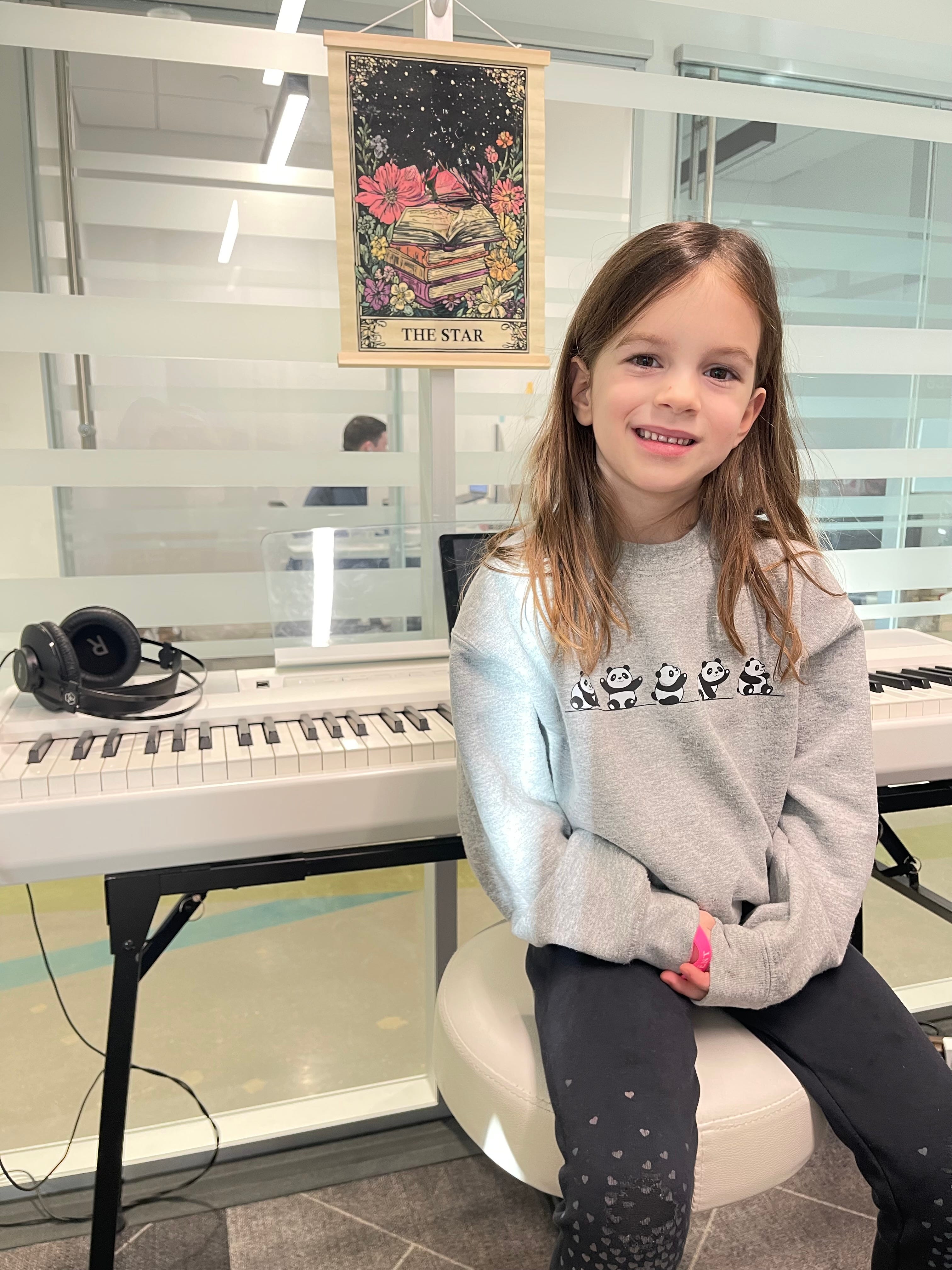
Student of the Month: Olivia
This month, we’re thrilled to celebrate Olivia as our Student of the Month.
During our recent stretch of snow days, while most of us were bundled up and waiting for the roads to clear, Olivia found her way to the piano—again and again. Over the course of the week, she spent nine joyful hours playing.
When asked what inspired her to play so much, her answer was beautifully simple:
“Because playing the piano makes me feel happy.”
That’s it.
That’s the whole reason.
Not a sticker.
Not a reward.
Not a reminder.
Just genuine joy.
This is exactly the kind of relationship with music we hope every child develops—a place they want to return to, especially when the world slows down. Olivia reminded us that practice doesn’t always look like discipline or effort. Sometimes it looks like curiosity, comfort, and choosing something that feels good.
We’re so proud of you, Olivia. Thank you for showing us what it looks like when music becomes a true companion. 🎹💜